Ann Nyberg: Att Skapa är att Leva — To Create Is to Live
Curatorial Review by Despina Tunberg
There is something quietly radical about devoting a lifetime to fiber. In an era when contemporary art discourse gravitates towards the conceptually fashionable, the digitally mediated, and the spectacularly large-scale, Ann Nyberg has spent overfour decades perfecting a practice grounded in the physical, the handmade, and the deeply felt. The result is a body of work of remarkable consistency and emotional intelligence — a sustained meditation on the human figure, on color as language, and on the loom as a thinking tool.
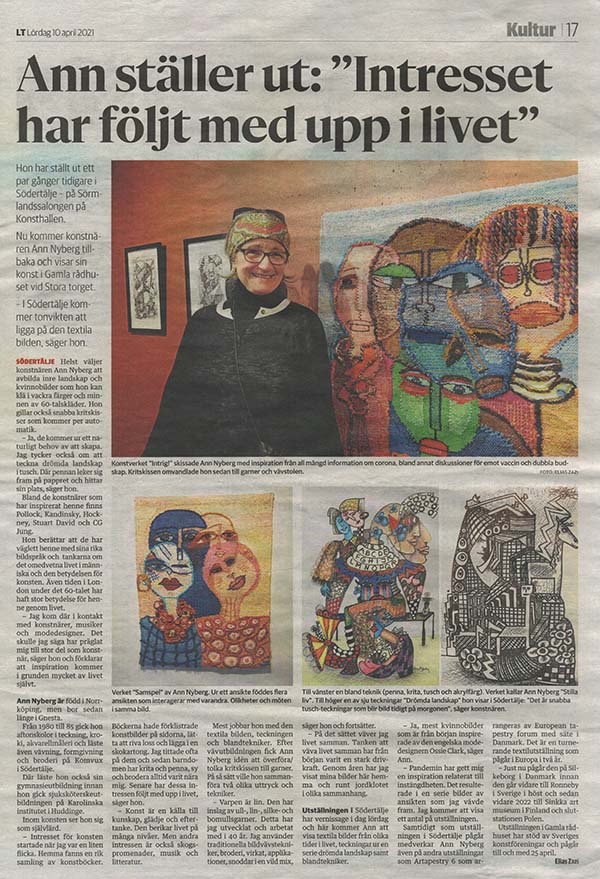
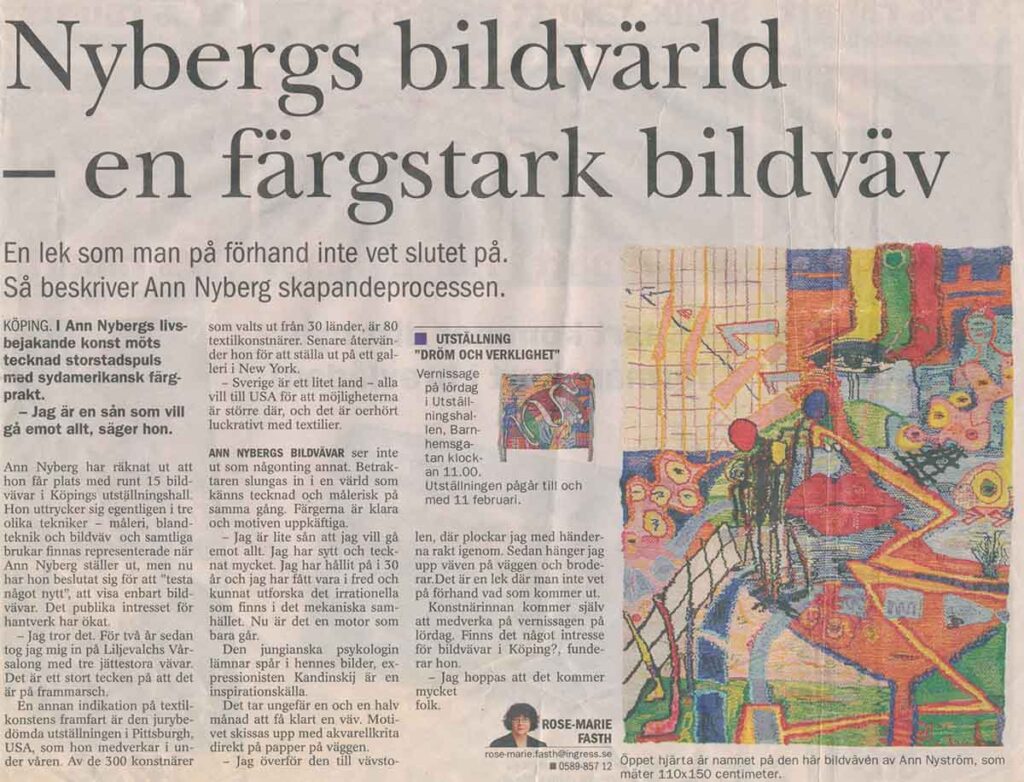
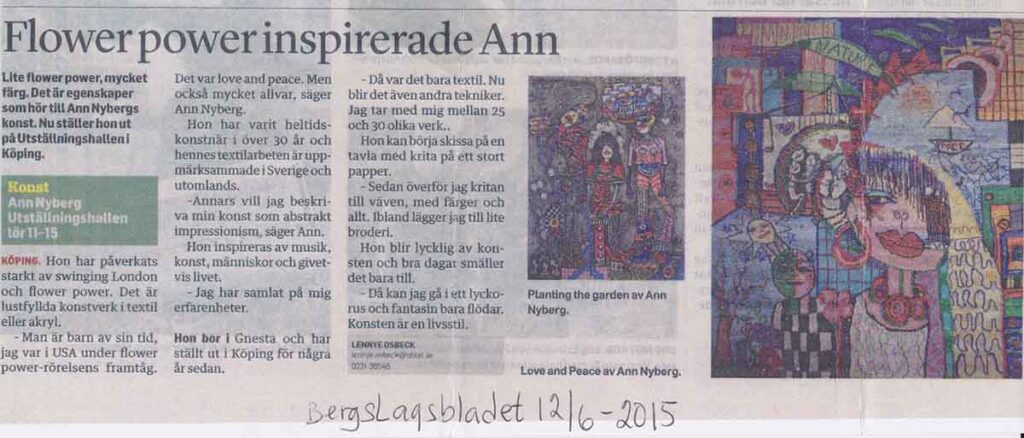
Born in Norrköping, Sweden, Nyberg has worked as an artist since the early 1980s, with textile art at the core of herpractice. Her formation was unconventional and largely self-directed. In the late 1960s she lived in an artists’ commune in central London, immersing herself in the art, fashion and music of that transformative moment, and it was there that shecontinued developing her drawing. The influence of that era — its energy, its chromatic boldness, its irreverence — has never left her. She cites fashion designer Ossie Clark as a formative influence, and the women who populate her figurative works carry a lingering echo of that late-1960s aesthetic: expressive, color-saturated, emotionally sovereign.
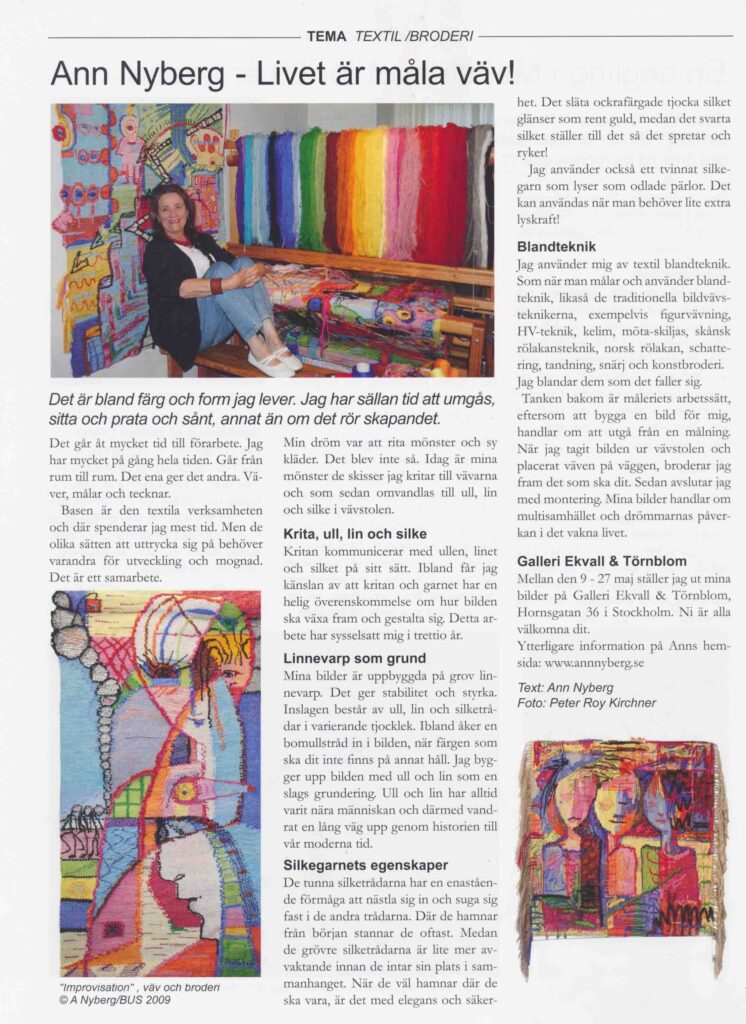
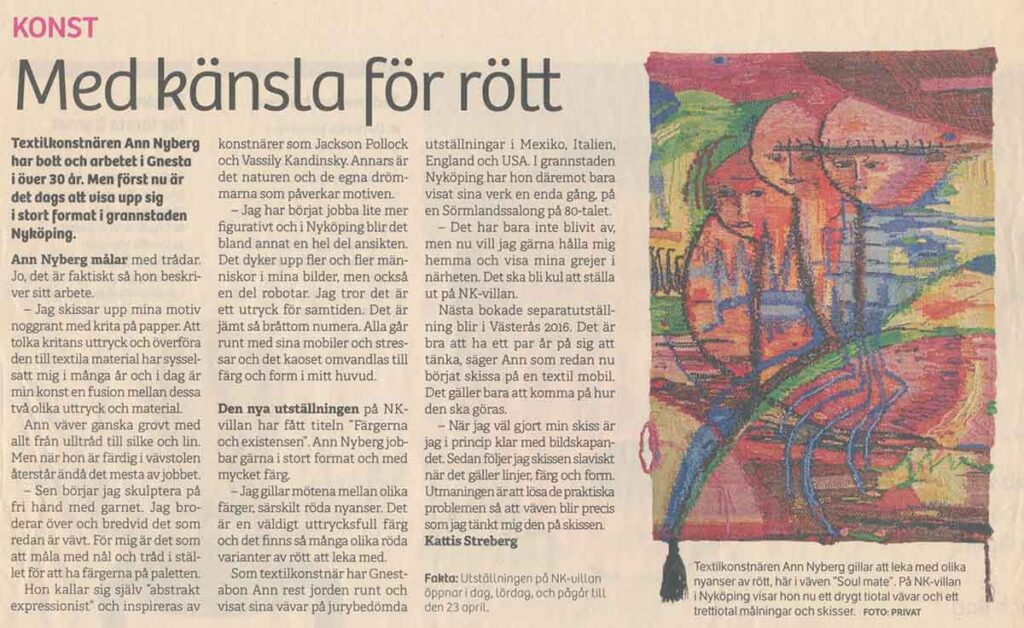
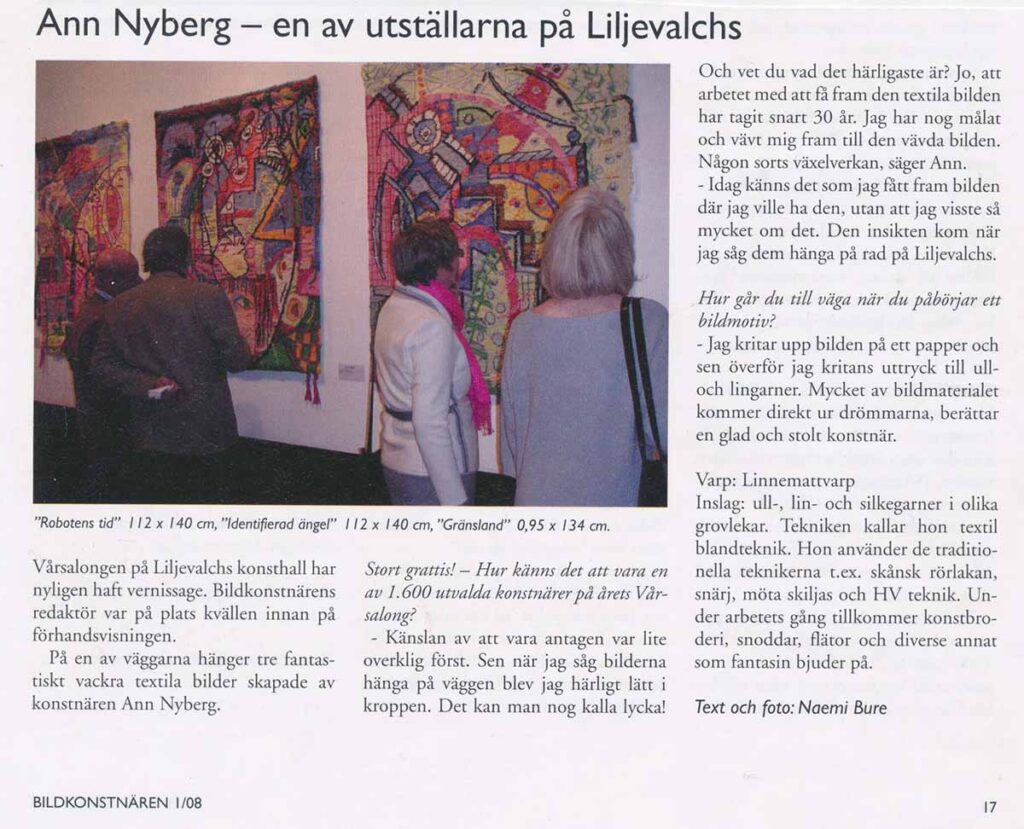
Her primary medium is what she calls Textil Blandteknik — mixed fiber art — a fusion she has developed over decadesthat begins with intuitive crayon sketches and translates them into large-scale weavings on a linen warp, using wool, linen, silk and cotton yarns, then completed on the wall with additional embroidery, appliqué, crocheted elements, cordsand buttons. The process is as important as the object. Nyberg describes the crayon as “the creator” — a first line appears, then a complementary color responds, and from that initial dialogue the composition evolves almost autonomously until it declares itself complete. This trust in intuition over calculation gives her work its characteristic vitality: the sense that the image arrived rather than was constructed.
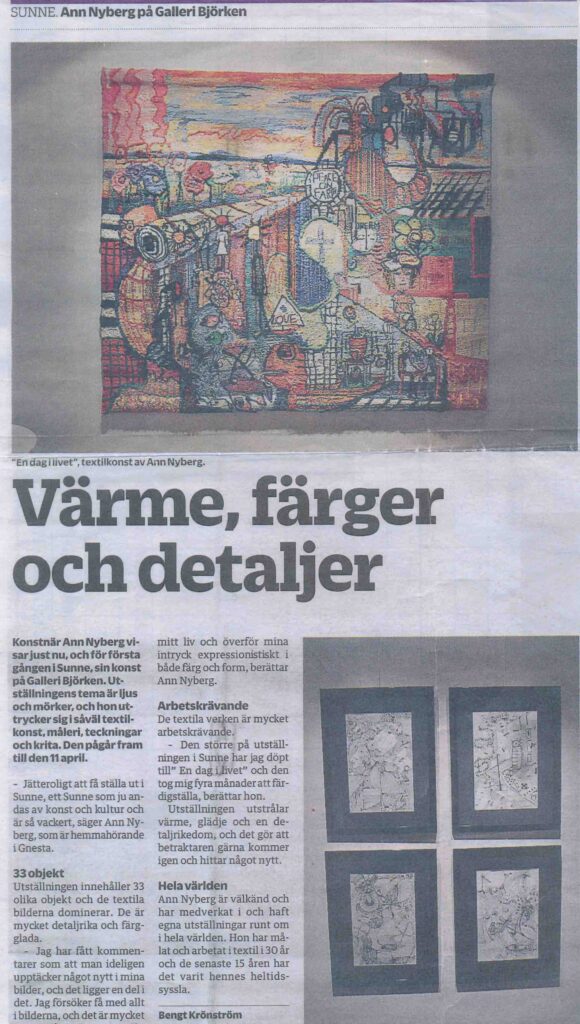
The large-scale weavings — Väv — form the majestic spine of the portfolio. Works such as Pushing the Limits (154 x 146 cm), Improvisation – New World, and A Bit of Heaven demonstrate the full range of her formal ambition. These are not decorative textiles; they are paintings made in fiber, and they demand the same quality of attention. Titles like Crossing Borders, Free Falling, and Catharsis signal the psychological and philosophical registers she habitually occupies. Her stated inspiration draws from abstract expressionism and its followers and in the weaving series this lineageis palpable — one finds echoes of Klee’s spatial play, of de Kooning’s gestural energy — yet the work is never derivative. The hand is always unmistakably Nyberg’s own.
Her figurative practice — rendered in mixed technique on paper and canvas at smaller scale — centers almost exclusively on women, and these works constitute a parallel world within the broader practice. The women she depictswere inspired by female figures from the songs of late-
1950s and 1960s musicians — Chuck Berry’s Little Queenie, Fats Domino’s Josephine — women she imagined and made her own, dressing them in color and giving them their own emotional expressions. The result is a quietly feminist iconography: these figures are never passive, never merely decorative. They stride, sit, gather, and dream with a palpableinterior life.
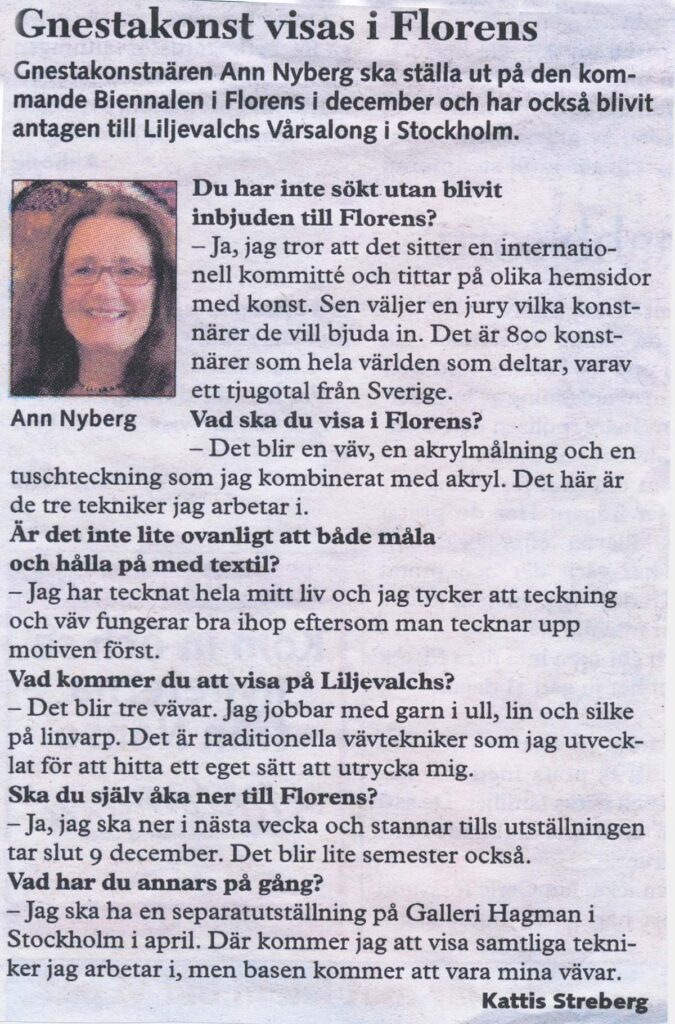
Nyberg’s work is held in public collections including the Latvian National Museum of Art in Riga, and municipalitiesacross Sweden. She has exhibited internationally on a regular basis and has received grants from both the Swedish Artist Association and the Swedish Arts Grants Committee (IASPIS).
What ultimately distinguishes Ann Nyberg is the coherence of her vision over time. There is no pivot, no reinvention for its own sake — only a deepening. Each series grows naturally from the last, the crayon line always at the origin, the loom always the destination. In a cultural moment that prizes novelty over mastery, hers is an art of patient, accumulated wisdom. Att skapa är att leva — to create is to live. In Nyberg’s case, the motto is not a slogan but a daily fact.
Despina Tunberg Curator
World Wide Art Books and Artavita Wwab.us and artavita.com
https://www.facebook.com/despina.tunberg.9
https://www.linkedin.com/in/despina-tunberg-0b872b22/